
Appearance
Semantic Keywords
Semantic Keywords
Semantic keywords are one of the most important parts of Content Audit — they directly drive your Content Score and reflect how Google evaluates topical depth.
What are semantic keywords?
Semantic keywords are recurring terms extracted from the top-ranking competitor articles for your target keyword. They represent the vocabulary Google expects to see when a page is genuinely about your topic.
For example, if your target keyword is "how to optimize Shopify for mobile", semantic keywords might include responsive design, page speed, Core Web Vitals, mobile checkout, theme optimization — terms that top-ranking articles consistently use to cover the topic thoroughly.
Why semantic keywords matter
Modern search engines don't just match the exact keyword you typed — they look at the full vocabulary of your page to decide whether your content actually covers the topic in depth. Pages that include the right semantic keywords signal to Google that the content is comprehensive and authoritative.
This is also how AI search engines (Google AI Overview, ChatGPT Search, Perplexity) decide which pages to cite in their answers — the more complete your topical coverage, the higher your chance of being referenced.
Where to find them in Content Audit
In the right panel, the Keyword Coverage section shows:
- All keywords — how many semantic keywords were extracted from competitors
- Covered / Uncovered — which keywords you've already used and which are missing
- Suggested frequency — how many times each keyword should appear (based on competitor averages)
- Headings tab — keywords that should appear specifically in your H2-H6 headings.
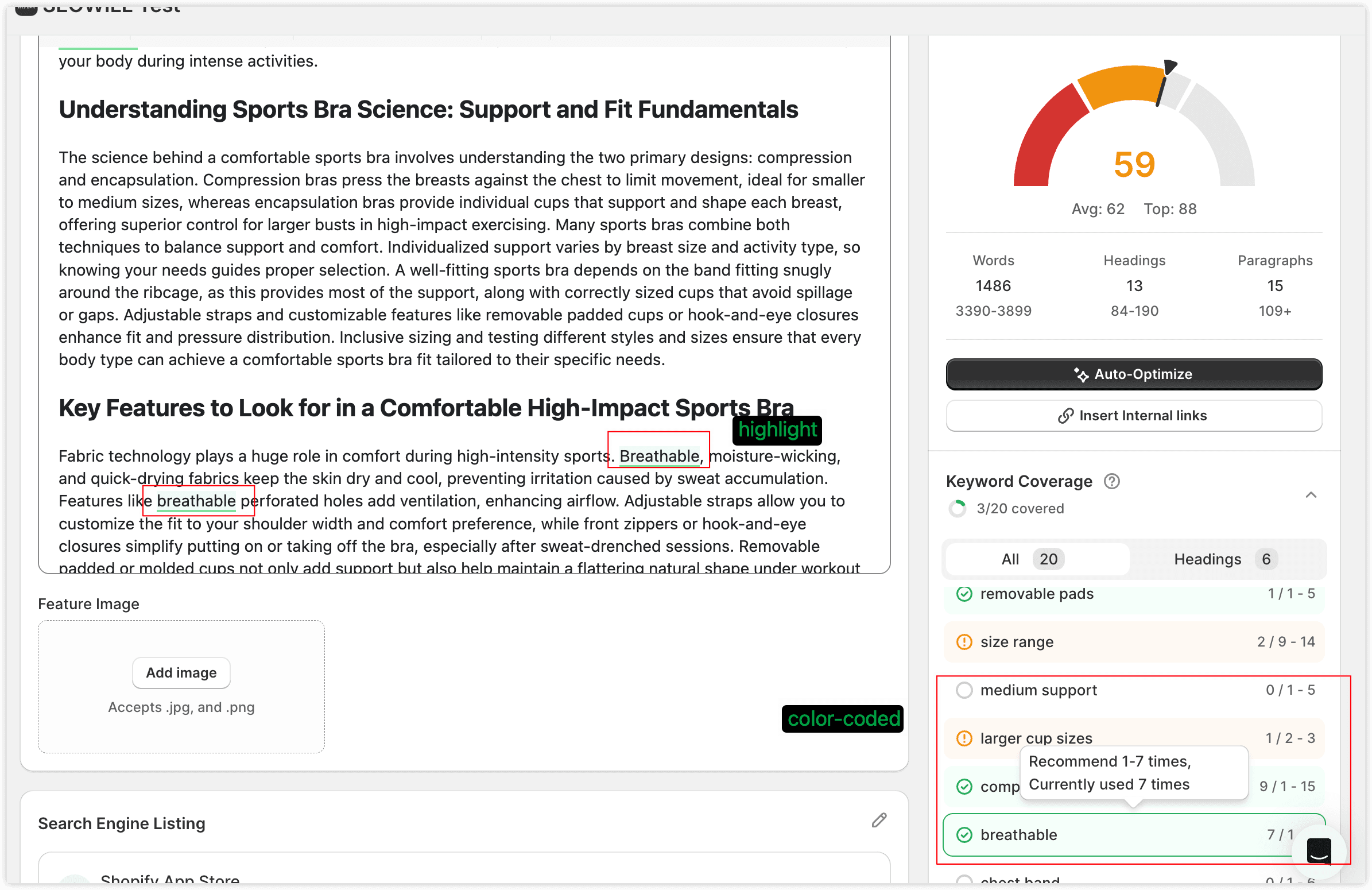
In the right panel, the Keyword Coverage section shows:
- Total keywords — how many semantic keywords were extracted from competitors
- Suggested frequency — how many times each keyword should appear, based on competitor averages
- Headings tab — keywords that should appear specifically in your H1/H2/H3 headings, not just in body text
- Covered / Uncovered — Each semantic keyword is color-coded to show its covered status in your content
| Color | Meaning |
|---|---|
| 🟢 Green | Keyword usage is within the suggested range — no action needed |
| 🟡 Yellow | Keyword appears too few or too many times — adjust frequency to match the suggested range |
| ⚪ Gray | Keyword is missing from your article — consider adding it |
Click any keyword in the list, and the editor on the left will automatically highlight every occurrence of that keyword in your article. This makes it easy to quickly review where a keyword is being used
How to use semantic keywords in your article
1. Write first, optimize second.
Don't start by stuffing keywords into a blank page. Write a natural draft based on the competitor outlines, then check which keywords are missing and integrate them.
2. Insert naturally within relevant context.
If a semantic keyword fits the paragraph's topic, use it. If it feels forced, skip it — unnatural keyword use hurts readability and can trigger Google's spam signals.
3. Prioritize uncovered high-frequency keywords.
Focus on keywords that appear frequently across competitors but are missing from your article. These have the biggest impact on your Content Score.
4. Match the suggested frequency — approximately.
If a keyword is suggested 3–5 times, using it 3 times is enough. Don't repeat it 10 times to "maximize" — excessive repetition lowers your score instead of raising it.
Common mistakes to avoid
| Mistake | What to do instead |
|---|---|
| Copying keywords into a "keyword list" at the end of your article | Integrate them into actual paragraphs where they fit naturally |
| Forcing every single keyword | Skip keywords that don't fit your angle — covering 70–80% naturally beats covering 100% awkwardly |
| Using exact-match variants stacked together (e.g. "running shoes, best running shoes, running shoes for women") | Use each term in its natural context, separated across different paragraphs |
| Ignoring heading keywords | Rewrite one or two H2-H6 headings to include suggested heading keywords |
| Over-optimizing to hit 100% coverage | Aim for a score 10–20 points above top competitors — that's enough |
Tip: Let Auto-Optimize do the heavy lifting
If you've finished writing but are struggling to work in the last batch of keywords naturally, click Auto-Optimize. Our algorithm will find the best opportunities to insert missing NLP terms while preserving your content's meaning. You can review each change before accepting.